I
It was a simple exchange. Professor Shafer asking, “Have you thought about grad school?” Me admitting I had not. Our Advanced Figure Drawing class was on a ten-minute break and stepping into the hallway we relaxed our hands as the now robed model stretched her arms and legs. “You probably should,” continued Shafer, “you’re one of our best students. Maybe Cranbrook. Joslin, Hagale, and Ortiz [three UW-Eau Claire Art Department faculty] all went there. It’s a great school.” As we returned to class, Andy caught my eye, “Think about it. I’ll write letters, make slides, whatever you need.”
Sixteen months later and newly married, C.K. and I moved from Wisconsin to a one-bedroom apartment in Pontiac, Michigan. I set to organizing my new studio in the Painting Department at Cranbrook and she started looking for work. Cranbrook’s existence was due entirely to the largess of George Gough Booth and his wife, Ellen Scripps Booth who, in 1907, purchased a 174 acre farm in Bloomfield Hills, Michigan. In 1925 they commissioned Finnish architect Ellul Saarinen to design a multi-faceted educational community. The Art Academy, one of Cranbrook’s several schools, completed in 1932, became an American iteration of the German Bauhaus. Saarinen was the Academy’s first president.
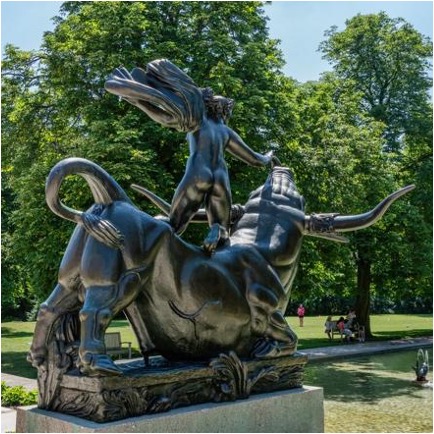
Storied Cranbrook was unlike my undergraduate program in telling ways. For instance, its abundant gardens were carefully tended. Sculptures were installed along walkways and reflecting pools. Europa and The Bull, a magnificent bronze sculpture, was visible from the east-facing window of my studio.[1] Some of my classmates hailed from high-culture families: offspring of composer Henry Mancini, architect Frank Lloyd Wright, and New Yorker cartoonist Saul Steinberg. At Cranbrook art talk and artmaking occurred 24/7 and I relished both.
By the end of my first semester, and after an especially harsh departmental critique, I considered dropping out. My sense of purpose was faltering, money was tight, and C.K. felt far from home. Though Andy knew nothing of my struggle, I received occasional unexpected notes from him and his sustained confidence in me strengthened my resolve to stay the course. The professor who taught me how to draw the figure and make a painting was becoming my mentor.
In the decades that followed, Andy and his wife, Barbara, traveled to see my work when they could. He dropped things of interest in the mail. And when I published my first book, he read it. If travels took me to Eau Claire, I often visited the Shafers in their studio or met them for coffee or a meal. Sometimes they invited me to dinner in their home and longer conversations about ideas, art, and life always followed. Andy was ever ready with affirmations, “You’re a good artist, your work is important, keep going.” What he didn’t know is that his generous words often posed a challenge. After completing my M.F.A. there were long seasons when I made little art. While I struggled to find a creative cadence, Andy’s zeal to make paintings never flagged. If a farmer ceases to plant and harvest crops, how long shall we consider him a farmer?
Understand, being an artist makes little worldly sense. Our openness to ambiguity, circumspection, and complexity seldom puts food on the table.[2] Without tangible material rewards, another kind of urgency is needed. For some the simple pleasures of making are enough. Others hunger for more, what George Steiner termed “real presence.” Art’s deeper work is soulish, a furnace of transformation wherein dross is skimmed off and gold refined. At least that’s the wager.
II
Andy and Barbara have shared a two-room studio at Banbury Place—a repurposed Uniroyal plant in Eau Claire, Wisconsin—for more than twenty years. Most mornings they arrive around 9:00 and work well into the afternoon. From atop Wisconsin Street, their second-story studio looks north and east across the city as it stretches upstream around a long bend in the Chippewa River toward the university. Downtown, the smaller Eau Claire River flows from the east to join the Chippewa and from this confluence the river travels west for 60 miles until it empties into the Mississippi.
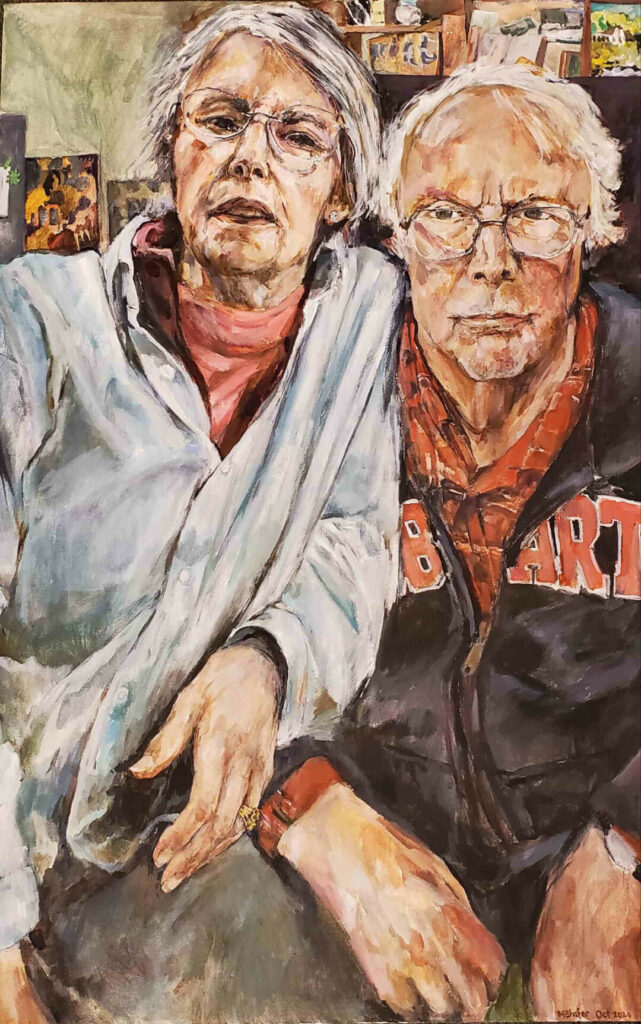
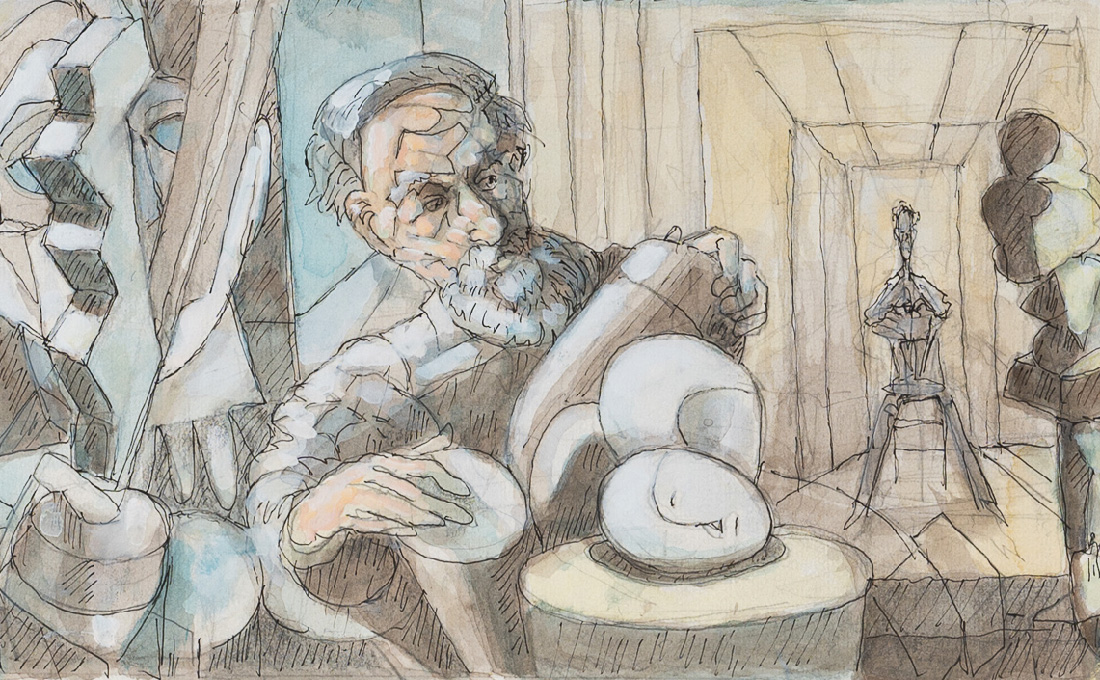
About a year ago, my relationship with Andy took a new turn. I commissioned him to create a work of art for me, one that examined the life and work of Constantin Brancusi and Alberto Giacometti.[3] In the weeks that followed, Barbara texted to say that Andy had started the piece. A few days later she forwarded an image adding, “Andy thinks it’s nearly done, but he wants your opinion.” Soon after, another text, “Andy has started a second painting.” Like fraternal twins, Giacometti-Brancusi I and Giacometti-Brancusi II, both rendered in watercolor, gouache, pencil, and ink on paper, entered the world. On a spring afternoon in April 2025 I traveled to Eau Claire to see the work.
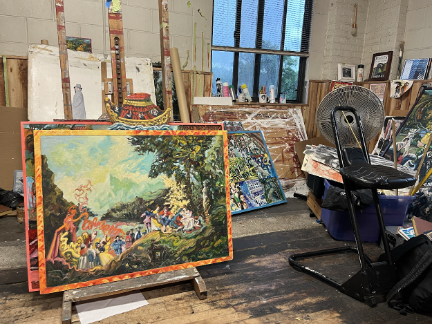
In Andy’s studio paintings line the walls three or four panels deep, watercolors and drawings are stacked high on side tables, paint tubes congregate according to their type, and brushes stand tall in repurposed jars. While there is a general order to the place, his body of work is subject to the continuous thrum of invention. Noticing a visual deficit, Andy might rework an older piece or, seeing an unrealized opportunity, affix a cutout figure to the frame of an already completed painting.
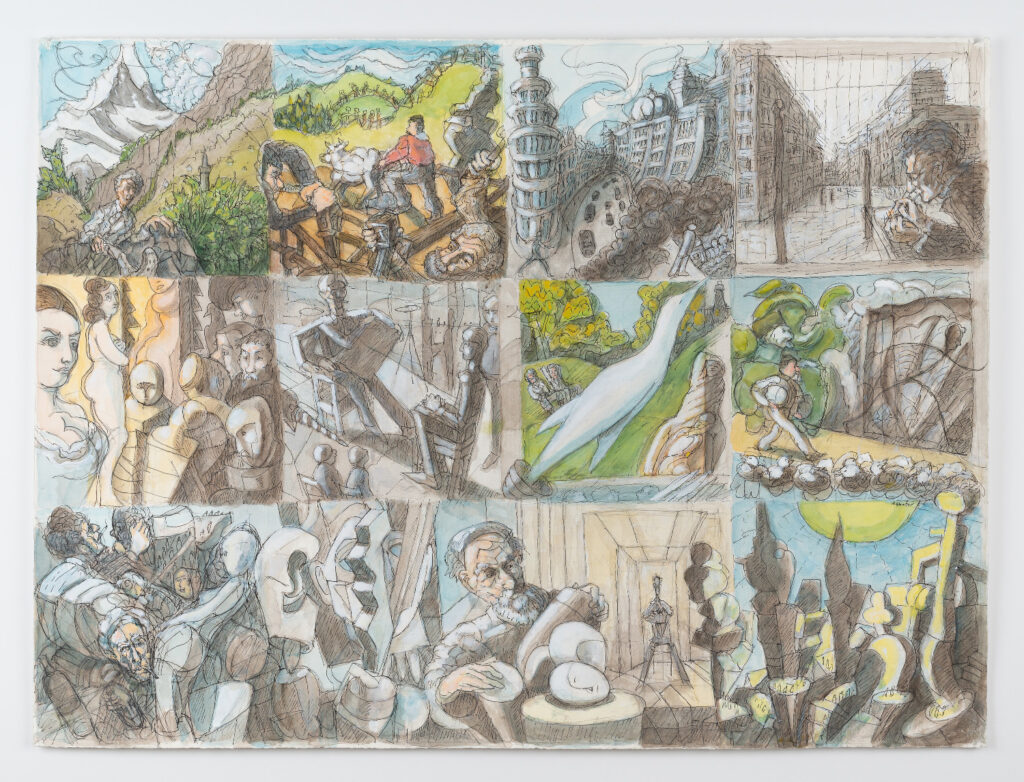
To construct the narrative of Giacometti-Brancusi I, Andy turned to a format he calls “sequence art,” a pictorial strategy that reads much like a graphic novel. In this work he depicts Brancusi and Giacometti setting out from home. In 1904 Constantin, raised in Hobița, a village near the Carpathian Mountains, left his Romanian Orthodox community and traveled to Paris. He was 28. Seventeen years later , Alberto, who hailed from Bregaglia, an Alpine village in Switzerland, having completed secondary education at a seminary boarding school, also made a pilgrimage to Paris. In the opening decades of the twentieth century, the artworld was being radically reconfigured, so also the lives of these young artists who would, after many years of struggle and deprivation, become some of Modern Art’s most celebrated figures.
Some vignettes in Giacometti-Brancusi I explore the Romanian’s eclectic visual vocabulary: folk culture, the onion domes of Bucharest, Asian and Indian design, and notably, Cubism. Two central frames in the bottom row feature both artists at work in their ateliers—Alberto posing a solitary model, Constantin arranging sculptural forms on a pedestal.
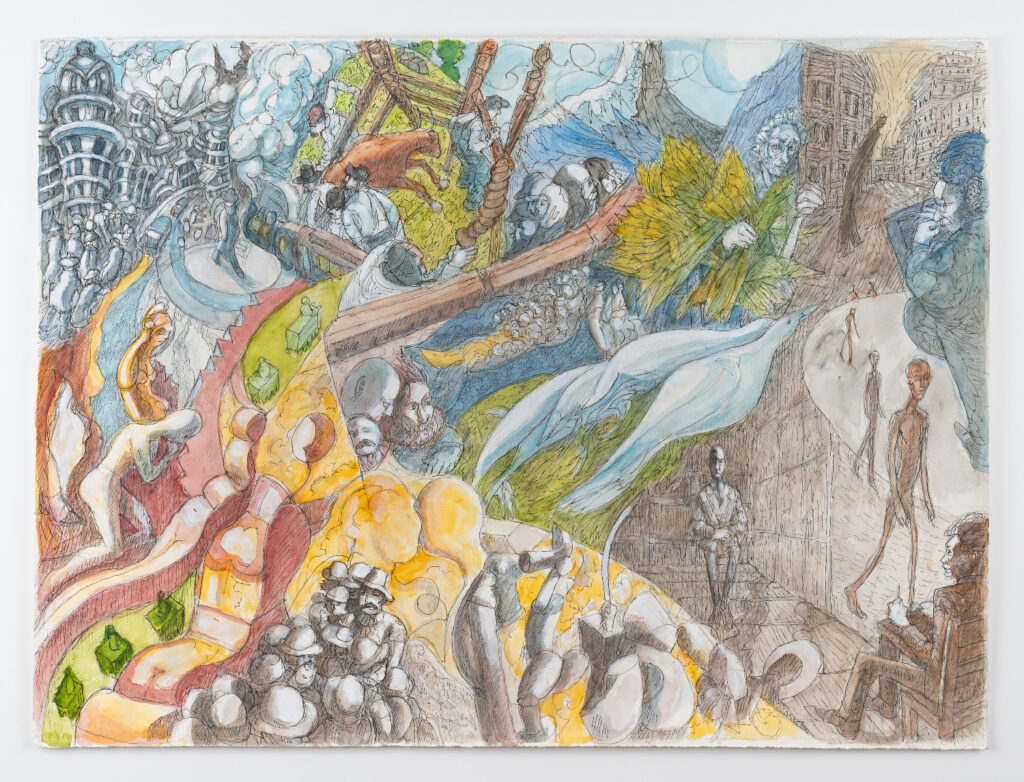
By comparison, the figurative forms in Giacometti-Brancusi II are more dynamic. Moving from bottom left to the upper right, the work showcases the rise of the industrial age and the demise of pastoral Europe. A train snakes up a mountain incline. A pair of bird shapes mimic flight, a gesture to Brancusi’s Bird in Space sculptures that he often carved in stone and cast in bronze. Meanwhile, Giacometti labors in a small studio that he and Diego, his younger brother, occupied for 43 years. Lifelong, Alberto pondered the darker reality of the modern alienated self and his series of Walking Man sculptures bear witness to his abiding ennui. In fact, his aesthetic struggle to draw, paint, and sculpt the human form in all of its existential complexity paired well with the pursuits of his philosopher friend, Jean-Paul Sartre.
III
When Andy builds an image, he begins with a continuous line drawing where his pencil never loses contact with the surface. Andy thinks and talks about art in the same manner. The history of art and ideas and his own experiences exist as a continual line of thought and reason. And so it was that afternoon. Andy and I had a magical conversation. We admired Brancusi and Giacometti’s objects, revisited what we knew of their biographies, and discussed art’s purpose and meaning.
At some point, Andy returned to Giacometti-Brancusi I. “I’m not sure it’s done. Maybe it needs something? What do you think?”
Ever Andy’s student, I offered, “Maybe you could strengthen the shadow shapes around the Brancusi figure in the bottom row?”
Nodding, he reached for a small brush, loaded it with gray-brown gouache, and layered in more pigment. “I think that’s better, don’t you?”
Measured against the scope and pace of contemporary life, it is tempting to believe that our lives, even the most exemplary, possess little agency. Good mentors demonstrate otherwise. While they cannot save us from the world or even ourselves, mentors call us to our best. It is their better nature to bless, and when choppy waters threaten, their wisdom often keeps our small vessels afloat. Now in his 80’s, Andy’s voice may be growing softer and hands less steady, but his clarity of purpose holds fast: Anders C. Shafer’s daily work is to make good paintings.
During the visit, I learned Anna Zook, Art Librarian at UW-Eau Claire and friend of the Shafers, was planning a retrospective exhibit of Andy’s work. Themed Meter & Medium: A Visual Festschrift for Anders Shafer the show was scheduled to open early in the 2025 Fall Semester. Anna invited me to contribute the lead essay for the catalog to accompany the show. I was honored to accept the challenge to write about the mentor who had taught me so much, and titled the piece, “At the Confluence.”
On my Writings page, you will find a PDF of the full Mentor & Medium catalog.
Notes:
[1] Milles was the Academy’s sculptor in residence from 1931-51. See Andrea P. A. Belloli, ed., Design in America: The Cranbrook Vision 1925-50 (New York: Metropolitan Museum of Art, 1984). In 1989, Cranbrook was designated a U.S. National Historic Landmark.
[2] Building on the groundbreaking work of philosopher and neuroscientist Ian McGilchrist, Paul Kingsnorth outlines how the left and right hemispheres of our brain function. The former is given to ap-prehension and the later, com-prehension. According to this scheme, artists are generally right-brain dominant. See Paul Kingsnorth, “The West Must Die,” Against the Machine: The Unmaking of Humanity (New York: Thesis, 2025), 265-272.
[3] Cameron Anderson, “Transcendence and Immanence: The Sculpture of Constantin Brancusi and Alberto Giacometti” in Cameron J. Anderson and G. Walter Hansen, eds. God in the Modern Wing: Viewing Art with Eyes of Faith (Downers Grove, IL: IVP Academic, 2021), 50-68.
Photography by Barry Sherbeck of Andy Shafer’s drawings.